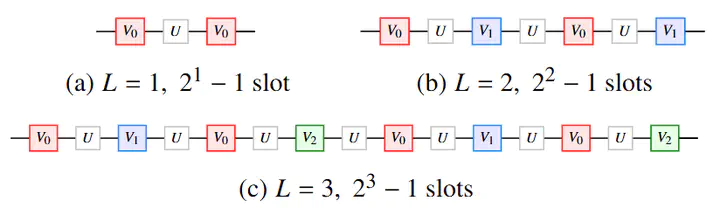
 Inverse protocol based on recurrence idea.
Abstract
Unknown unitary inversion is a fundamental primitive in quantum computing and physics. Although recent work has demonstrated that quantum algorithms can invert arbitrary unknown unitaries without accessing their classical descriptions, improving the efficiency of such protocols remains an open question. In this work, we present efficient quantum algorithms for inverting unitaries with specific Hamiltonian structures, achieving significant reductions in both ancilla qubit requirements and unitary query complexity. We identify cases where unitaries encoding exponentially many parameters can be inverted using only a single query. We further extend our framework to implement unitary complex conjugation and transposition operations, and develop modified protocols capable of inverting more general classes of Hamiltonians. We have also demonstrated the efficacy and robustness of our algorithms via numerical simulations under realistic noise conditions of superconducting quantum hardware. Our results establish more efficient protocols that improve the resources required for quantum unitary inversion when prior information about the quantum system is available, and provide practical methods for implementing these operations on near-term quantum devices.
Yin Mo
Research Associate
I obtained my BS in Fundamental Science in Physics and Mathematics from Tsinghua University. I obtained my PhD degree in Computer Science from the University of Hong Kong. My research interests include quantum information theory, quantum supermaps and quantum machine learning.
Tengxiang Lin
PhD Student (co, 2025)
I obtained my B.E. in Information Engineering from South China University of Technology. My research interests include quantum information theory and quantum computation.
Xin Wang
Associate Professor
Prof. Xin Wang founded the QuAIR Lab at HKUST (Guangzhou) in June 2023. His research aims to advance our understanding of the limits of information processing with quantum systems and the potential of quantum artificial intelligence. His current interests include quantum algorithms, quantum resource theory, quantum machine learning, quantum computer architecture, and quantum error processing. Prior to establishing the QuAIR Lab, Prof. Wang was a Staff Researcher at the Institute for Quantum Computing at Baidu Research, where he focused on quantum computing research and the development of the Baidu Quantum Platform. Notably, he led the development of Paddle Quantum, a Python library for quantum machine learning. From 2018 to 2019, he was a Hartree Postdoctoral Fellow at the Joint Center for Quantum Information and Computer Science (QuICS) at the University of Maryland, College Park. Prof. Wang received his Ph.D. in quantum information from the University of Technology Sydney in 2018, under the supervision of Prof. Runyao Duan and Prof. Andreas Winter. He obtained his B.S. in mathematics (Wu Yuzhang Honors) from Sichuan University in 2014.