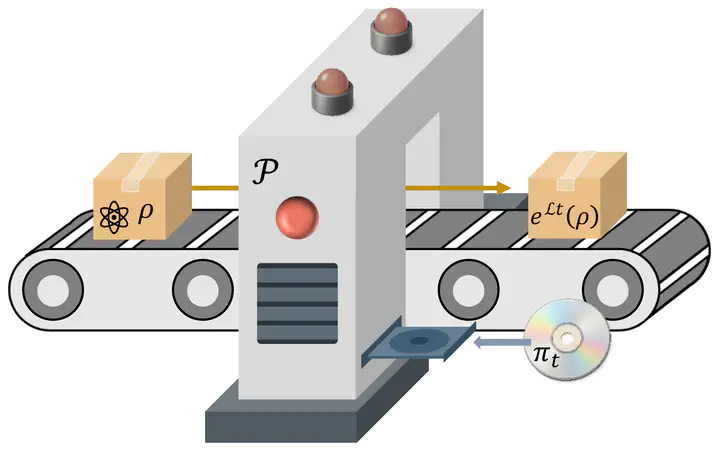
 Overview diagram of programming open-system dynamics
Abstract
Programmability is a unifying paradigm for enacting families of quantum transformations via fixed processors and program states, with a fundamental role and broad impact in quantum computation and control. While there has been a shift from viewing open systems solely as a source of error to treating them as a computational resource, their programmability remains largely unexplored. In this work, we develop a framework that characterizes and quantifies the programmability of Lindbladian semigroups by combining physically implementable retrieval maps with time varying program states. Within this framework, we identify quantum programmable classes enabled by symmetry and stochastic structure, including covariant semigroups and fully dissipative Pauli Lindbladians with finite program dimension. We further provide a necessary condition for physical programmability that rules out coherent generators and typical dissipators generating amplitude damping. For such nonphysically programmable cases, we construct explicit protocols with finite resources. Finally, we introduce an operational programming cost, defined via the number of samples required to program the Lindbladian, and establish its core structural properties, such as continuity and faithfulness. These results provide a notion of programming cost for Lindbladians, bridge programmable channel theory and open system dynamics, and yield symmetry driven compression schemes and actionable resource estimates for semigroup simulation and control in noisy quantum technologies.
Mingrui Jing
PhD Student (2023)
I obtained my BS and MS degrees in physics from the University of Melbourne. My research interests include distributed quantum computing, quantum entanglement and quantum machine learning.
Mengbo Guo
Research Assistant
I obtained my BS in Physics from Wuhan University under the supervision of Prof. Wenxian Zhang. I obtained my MS degree in Physics from Hong Kong University of Science and Technology under the supervision of Prof. Gyu-boong Jo. My research interests include quantum computation and quantum error correction.
Lin Zhu
PhD Student (2025)
I obtained my MEng in Materials Science in University of Oxford under the supervision of Prof. Simon Benjamin. My research interests include quantum information theory, quantum computation and quantum hardware
Hongshun Yao
PhD Student (2024)
I obtained my BS degree in Mathematics from Nanjing University of Aeronautics and Astronautics and my MS degree in Mathematics from Beihang University. My research interests include quantum information theory and quantum machine learning.
Xin Wang
Associate Professor
Prof. Xin Wang founded the QuAIR Lab at HKUST (Guangzhou) in June 2023. His research aims to advance our understanding of the limits of information processing with quantum systems and the potential of quantum artificial intelligence. His current interests include quantum algorithms, quantum resource theory, quantum machine learning, quantum computer architecture, and quantum error processing. Prior to establishing the QuAIR Lab, Prof. Wang was a Staff Researcher at the Institute for Quantum Computing at Baidu Research, where he focused on quantum computing research and the development of the Baidu Quantum Platform. Notably, he led the development of Paddle Quantum, a Python library for quantum machine learning. From 2018 to 2019, he was a Hartree Postdoctoral Fellow at the Joint Center for Quantum Information and Computer Science (QuICS) at the University of Maryland, College Park. Prof. Wang received his Ph.D. in quantum information from the University of Technology Sydney in 2018, under the supervision of Prof. Runyao Duan and Prof. Andreas Winter. He obtained his B.S. in mathematics (Wu Yuzhang Honors) from Sichuan University in 2014.