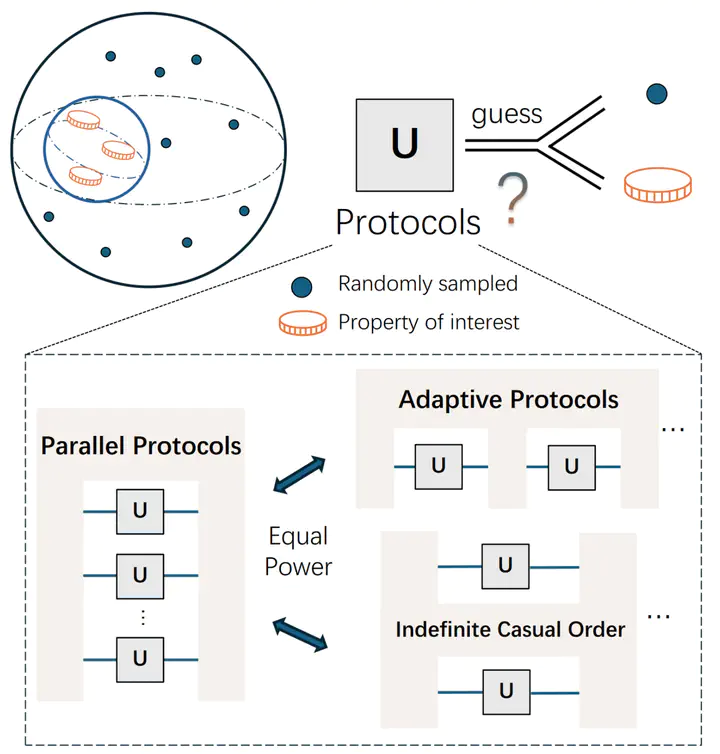
 Hypothesis testing for quantum dynamics
Abstract
Identifying symmetries in quantum dynamics, such as identity or time-reversal invariance, is a crucial challenge with profound implications for quantum technologies. We introduce a unified framework combining group representation theory and subgroup hypothesis testing to predict these symmetries with optimal efficiency. By exploiting the inherent symmetry of compact groups and their irreducible representations, we derive an exact characterization of the optimal type-II error (failure probability to detect a symmetry), offering an operational interpretation for the quantum max-relative entropy. In particular, we prove that parallel strategies achieve the same performance as adaptive or indefinite-causal-order protocols, resolving debates about the necessity of complex control sequences. Applications to the singleton group, maximal commutative group, and orthogonal group yield explicit results: for predicting the identity property, Z-symmetry, and T-symmetry of unknown qubit unitaries, with zero type-I error and type-II error bounded by
Yu-Ao Chen
Visiting Scholar
I obtained my BS in Mathematics and Applied Mathematics from University of Science and Technology of China. I obtained my PhD degree in Applied Mathematics from University of Chinese Academy of Sciences under the supervision of Prof. Xiao-Shan Gao. My research interests include quantum computing, symbolic computation and cryptanalysis.

Chenghong Zhu
PhD Student (2023)
I obtained my BS and MS degrees in computer science from the University of Melbourne. My research interests include distributed quantum computing, quantum entanglement and quantum machine learning.
Xin Wang
Associate Professor
Prof. Xin Wang founded the QuAIR Lab at HKUST (Guangzhou) in June 2023. His research aims to advance our understanding of the limits of information processing with quantum systems and the potential of quantum artificial intelligence. His current interests include quantum algorithms, quantum resource theory, quantum machine learning, quantum computer architecture, and quantum error processing. Prior to establishing the QuAIR Lab, Prof. Wang was a Staff Researcher at the Institute for Quantum Computing at Baidu Research, where he focused on quantum computing research and the development of the Baidu Quantum Platform. Notably, he led the development of Paddle Quantum, a Python library for quantum machine learning. From 2018 to 2019, he was a Hartree Postdoctoral Fellow at the Joint Center for Quantum Information and Computer Science (QuICS) at the University of Maryland, College Park. Prof. Wang received his Ph.D. in quantum information from the University of Technology Sydney in 2018, under the supervision of Prof. Runyao Duan and Prof. Andreas Winter. He obtained his B.S. in mathematics (Wu Yuzhang Honors) from Sichuan University in 2014.