Abstract
Quantum autoencoder is an efficient variational quantum algorithm for quantum data compression. However, previous quantum autoencoders fail to compress and recover high-rank mixed states. In this work, we discuss the fundamental properties and limitations of the standard quantum autoencoder model in more depth, and provide an information-theoretic solution to its recovering fidelity. Based on this understanding, we present a noise-assisted quantum autoencoder algorithm to go beyond the limitations, our model can achieve high recovering fidelity for general input states. Appropriate noise channels are used to make the input mixedness and output mixedness consistent, the noise setup is determined by measurement results of the trash system. Compared with the original quantum autoencoder model, the measurement information is fully used in our algorithm. In addition to the circuit model, we design a (noise-assisted) adiabatic model of quantum autoencoder that can be implemented on quantum annealers. We verified the validity of our methods through compressing the thermal states of transverse field Ising model. For pure state ensemble compression, we also introduce a projected quantum autoencoder algorithm. Our models have wide applications for quantum data compression on near-term quantum devices.
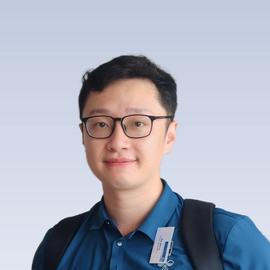
Xin Wang
Associate Professor
Prof. Xin Wang founded the QuAIR Lab at HKUST (Guangzhou) in June 2023. His research aims to advance our understanding of the limits of information processing with quantum systems and the potential of quantum artificial intelligence. His current interests include quantum algorithms, quantum resource theory, quantum machine learning, quantum computer architecture, and quantum error processing. Prior to establishing the QuAIR Lab, Prof. Wang was a Staff Researcher at the Institute for Quantum Computing at Baidu Research, where he focused on quantum computing research and the development of the Baidu Quantum Platform. Notably, he led the development of Paddle Quantum, a Python library for quantum machine learning. From 2018 to 2019, he was a Hartree Postdoctoral Fellow at the Joint Center for Quantum Information and Computer Science (QuICS) at the University of Maryland, College Park. Prof. Wang received his Ph.D. in quantum information from the University of Technology Sydney in 2018, under the supervision of Prof. Runyao Duan and Prof. Andreas Winter. He obtained his B.S. in mathematics (Wu Yuzhang Honors) from Sichuan University in 2014.