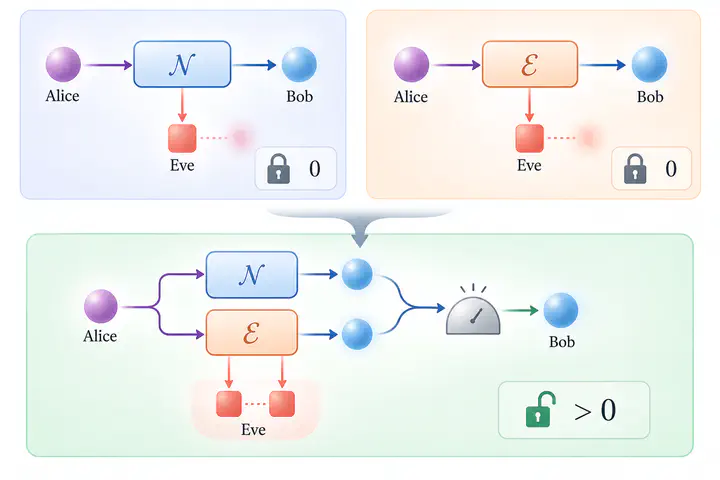
 Superactivation of private communication by two zero-private-capacity channels.
Abstract
Private communication over a noisy quantum channel requires reliable transmission to the receiver and secrecy from the environment. Whether two channels with zero private capacity can jointly enable private communication is a longstanding open problem in quantum information theory. Here we resolve this problem by exhibiting a four-level channel and a qubit erasure channel with half erasure probability, each with zero private capacity, whose joint use achieves more than 0.0001903 private bits per product use. The encoding gives the receiver a linear information gain with at most quadratic environmental leakage, enabling privacy through a fixed joint measurement and classical coding. This superactivation, impossible for independent classical memoryless wiretap channels, shows that a channel’s private capacity alone does not determine its value for secure communication. The initial activation example was identified through interactions with large language models, and the result has been formalized in Lean 4.
Chengkai Zhu
PhD Graduate
Xin Wang
Associate Professor
Prof. Xin Wang founded the QuAIR Lab at HKUST (Guangzhou) in June 2023. His research aims to advance our understanding of the limits of information processing with quantum systems and the potential of quantum artificial intelligence. His current interests include quantum algorithms, quantum resource theory, quantum machine learning, quantum computer architecture, and quantum error processing. Prior to establishing the QuAIR Lab, Prof. Wang was a Staff Researcher at the Institute for Quantum Computing at Baidu Research, where he focused on quantum computing research and the development of the Baidu Quantum Platform. Notably, he led the development of Paddle Quantum, a Python library for quantum machine learning. From 2018 to 2019, he was a Hartree Postdoctoral Fellow at the Joint Center for Quantum Information and Computer Science (QuICS) at the University of Maryland, College Park. Prof. Wang received his Ph.D. in quantum information from the University of Technology Sydney in 2018, under the supervision of Prof. Runyao Duan and Prof. Andreas Winter. He obtained his B.S. in mathematics (Wu Yuzhang Honors) from Sichuan University in 2014.