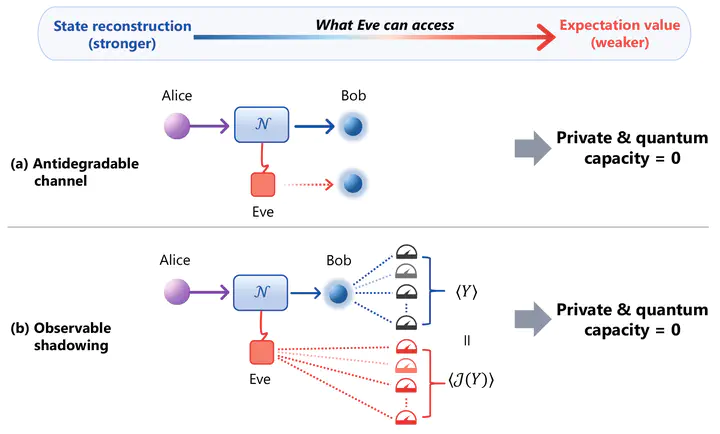
 Complete observable shadowing forces private and quantum capacities to vanish.
Abstract
Quantum communication is ruled out when an eavesdropper can reconstruct the receiver’s state. Yet states are operationally specified by measurement statistics, raising a sharper question: can access to every expectation value destroy communication? We show that it can. We call unbiased, variance-nonincreasing reconstruction under arbitrary reference extensions complete observable shadowing and prove that it forces unassisted private and quantum capacities to vanish. An explicit qutrit channel realizes this mechanism while being neither antidegradable nor PPT, resolving the long-standing questions of whether quantum capacity can vanish outside those two classes and whether antidegradability is the only route to zero private capacity. Notably, it superactivates every finite-dimensional channel with zero quantum but positive private capacity. Statistical access can therefore preclude standalone communication without erasing latent coherent utility.
Chengkai Zhu
PhD Graduate
Xin Wang
Associate Professor
Prof. Xin Wang founded the QuAIR Lab at HKUST (Guangzhou) in June 2023. His research aims to advance our understanding of the limits of information processing with quantum systems and the potential of quantum artificial intelligence. His current interests include quantum algorithms, quantum resource theory, quantum machine learning, quantum computer architecture, and quantum error processing. Prior to establishing the QuAIR Lab, Prof. Wang was a Staff Researcher at the Institute for Quantum Computing at Baidu Research, where he focused on quantum computing research and the development of the Baidu Quantum Platform. Notably, he led the development of Paddle Quantum, a Python library for quantum machine learning. From 2018 to 2019, he was a Hartree Postdoctoral Fellow at the Joint Center for Quantum Information and Computer Science (QuICS) at the University of Maryland, College Park. Prof. Wang received his Ph.D. in quantum information from the University of Technology Sydney in 2018, under the supervision of Prof. Runyao Duan and Prof. Andreas Winter. He obtained his B.S. in mathematics (Wu Yuzhang Honors) from Sichuan University in 2014.