Entanglement cost of bipartite quantum channel discrimination under positive partial transpose operations
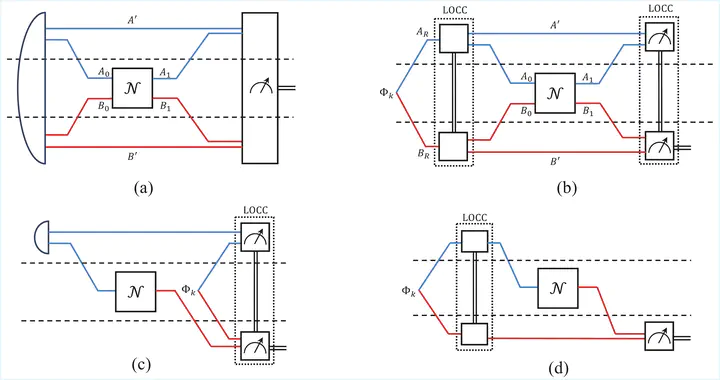 Protocols for bipartite channel discrimination.
Abstract
Quantum channel discrimination is a fundamental task in quantum information processing. In the one-shot regime, discrimination between two candidate channels is characterized by the diamond norm. Beyond this basic setting, however, many scenarios in distributed quantum information processing remain unresolved, motivating notions of distinguishability that capture the power of the available resources. In this work, we formulate a theory of testers for bipartite channel discrimination, leading to the concept of the entanglement cost of bipartite channel discrimination: the minimum Schmidt rank $k$ of a shared maximally entangled state required for local protocols to achieve the globally optimal success probability. We introduce $k$-injectable testers as a tester-based description of entanglement-assisted local discrimination and, in particular, study the class of k-injectable positive-partial-transpose (PPT) testers, which constitutes a numerically tractable relaxation of the practically relevant class of LOCC testers. For every $k$, we derive a semidefinite program (SDP) for the optimal success probability, which in turn yields an efficiently computable one-shot PPT entanglement cost. To render these optimization problems numerically feasible, we prove a symmetry-reduction principle for covariant channel pairs, thereby reducing the effective dimension of the associated SDPs. Finally, by dualizing the SDP, we derive bounds on the composite channel-discrimination problem and illustrate our framework with proof-of-principle examples based on the depolarizing channel, the depolarized SWAP channel, and the Werner–Holevo channels.

Chengkai Zhu
PhD Student (2023)
I obtained my BS in Applied Mathematics from China Agricultural University under the supervision of Prof. Zhencai Shen. I obtained my MS degree in Cyberspace Security from University of Chinese Academy of Sciences under the supervision of Prof. Zhenyu Huang. My research interests include quantum information theory and quantum computation.

Shuyu He
Undergraduate Student
I am studying at The Hong Kong University of Science and Technology (Guangzhou). My research interests include quantum information theory and quantum computation.

Xin Wang
Associate Professor
Prof. Xin Wang founded the QuAIR Lab at HKUST (Guangzhou) in June 2023. His research aims to advance our understanding of the limits of information processing with quantum systems and the potential of quantum artificial intelligence. His current interests include quantum algorithms, quantum resource theory, quantum machine learning, quantum computer architecture, and quantum error processing. Prior to establishing the QuAIR Lab, Prof. Wang was a Staff Researcher at the Institute for Quantum Computing at Baidu Research, where he focused on quantum computing research and the development of the Baidu Quantum Platform. Notably, he led the development of Paddle Quantum, a Python library for quantum machine learning. From 2018 to 2019, he was a Hartree Postdoctoral Fellow at the Joint Center for Quantum Information and Computer Science (QuICS) at the University of Maryland, College Park. Prof. Wang received his Ph.D. in quantum information from the University of Technology Sydney in 2018, under the supervision of Prof. Runyao Duan and Prof. Andreas Winter. He obtained his B.S. in mathematics (Wu Yuzhang Honors) from Sichuan University in 2014.