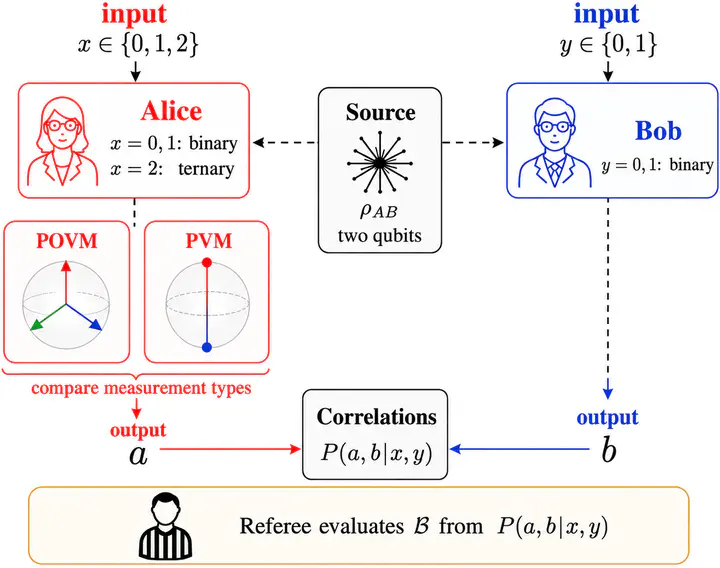
 Bell scenario for comparing qubit POVMs with qubit projective measurements.
Abstract
Generalized measurements can be implemented projectively after enlarging the Hilbert space, but this dilation changes the available local dimension. We construct a Bell functional with rational coefficients that separates the two measurement models at local dimension two. An explicit three-outcome qubit positive-operator-valued measure with rational matrix entries attains $2\sqrt{2} + 1/100$. On the other hand, all qubit-projective strategies are bounded by $2\sqrt{2} + \sqrt{5}/250 + \sqrt{2}/32400$, giving a fully analytic certified gap greater than 1/1000. To our knowledge, this is the first fully analytic Bell-functional separation between qubit POVMs and qubit projective measurements over arbitrary shared two-qubit states. A Lean certificate for the separation theorem is provided for completeness. Separately, an exact level-3 noncommutative sum-of-squares certificate proves that the explicit qubit strategy attains the unrestricted finite-dimensional tensor-product quantum optimum.
Lin Zhu
PhD Student (2025)
I obtained my MEng in Materials Science in University of Oxford under the supervision of Prof. Simon Benjamin. My research interests include quantum information theory, quantum computation and quantum hardware
Ranyiliu Chen
Visiting Scholar
I received my doctorate in Mathematics from the University of Copenhagen in 2025, under the supervision of Prof. Laura Mancinska. Previously I obtained my master’s and bachelor’s degrees in 2020 and 2017 respectively, both in electronic engineering from Beihang University. My research interests include quantum information theory, Bell non-locality and quantum machine learning.
Xin Wang
Associate Professor
Prof. Xin Wang founded the QuAIR Lab at HKUST (Guangzhou) in June 2023. His research aims to advance our understanding of the limits of information processing with quantum systems and the potential of quantum artificial intelligence. His current interests include quantum algorithms, quantum resource theory, quantum machine learning, quantum computer architecture, and quantum error processing. Prior to establishing the QuAIR Lab, Prof. Wang was a Staff Researcher at the Institute for Quantum Computing at Baidu Research, where he focused on quantum computing research and the development of the Baidu Quantum Platform. Notably, he led the development of Paddle Quantum, a Python library for quantum machine learning. From 2018 to 2019, he was a Hartree Postdoctoral Fellow at the Joint Center for Quantum Information and Computer Science (QuICS) at the University of Maryland, College Park. Prof. Wang received his Ph.D. in quantum information from the University of Technology Sydney in 2018, under the supervision of Prof. Runyao Duan and Prof. Andreas Winter. He obtained his B.S. in mathematics (Wu Yuzhang Honors) from Sichuan University in 2014.