Invariant Measures and Weak-Magic-Injection Asymptotics in Random Monitored Quantum Circuits
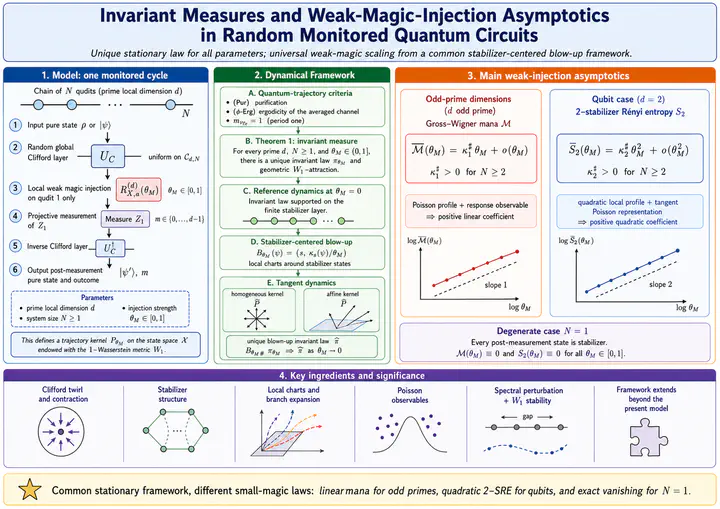 Framework of this work.
Abstract
Monitored quantum circuits provide a natural setting in which scrambling, measurements, and measurement-conditioned updates compete within a stochastic many-body dynamics. From the viewpoint of nonstabilizer resource theory, this competition is especially relevant because Clifford-compatible operations preserve the stabilizer structure, while weak non-Clifford perturbations inject magic resource. Most of the existing understanding of monitored quantum circuits has been shaped by numerical simulations and phenomenological descriptions, while a rigorous dynamics theory remains less developed. In this paper, we address this gap by developing an analytical framework which lays a rigorous mathematical foundation for the study of random monitored quantum dynamics. Specifically, we study a class of monitored quantum circuits driven by random Clifford. We prove the existence and uniqueness of the stationary law, which gives an ergodic description of the long-time dynamics. We then resolve the leading asymptotics of steady magic in the weak-magic-injection limit. This tangent description makes the contrast between resource measures transparent: in odd-prime local dimension, the steady Gross–Wigner mana has a linear leading asymptotic, whereas in qubit systems the steady 2-stabilizer Rényi entropy has a quadratic leading asymptotic. These different powers reflect the distinct local geometries of the two resource measures near the stabilizer layer. In this way, this work develops an analytical framework that first establishes the stationary ergodic dynamics of random monitored quantum circuits.

Guocheng Zhen
PhD Student (2025)
I have received my bachelor's degree in mathematics from Wuhan University in 2022 and my master's degree in mathematics from Wuhan University in 2025. My main research is about probability theory, especially Large Random Dimension Matrices Theory. I am exploring the mathematical foundation in quantum information under the guidance of Prof. Xin Wang and Prof. Bartosz Regula.

Xuanrong Yang
MPhil (2025)
I obtained my BS in Mathematics and Applied Mathematics from Harbin Institute of Technology (Weihai). My research interests include artificial intelligence and quantum computation.

Chengkai Zhu
PhD Graduate

Ranyiliu Chen
Visiting Scholar
I received my doctorate in Mathematics from the University of Copenhagen in 2025, under the supervision of Prof. Laura Mancinska. Previously I obtained my master’s and bachelor’s degrees in 2020 and 2017 respectively, both in electronic engineering from Beihang University. My research interests include quantum information theory, Bell non-locality and quantum machine learning.

Xin Wang
Associate Professor
Prof. Xin Wang founded the QuAIR Lab at HKUST (Guangzhou) in June 2023. His research aims to advance our understanding of the limits of information processing with quantum systems and the potential of quantum artificial intelligence. His current interests include quantum algorithms, quantum resource theory, quantum machine learning, quantum computer architecture, and quantum error processing. Prior to establishing the QuAIR Lab, Prof. Wang was a Staff Researcher at the Institute for Quantum Computing at Baidu Research, where he focused on quantum computing research and the development of the Baidu Quantum Platform. Notably, he led the development of Paddle Quantum, a Python library for quantum machine learning. From 2018 to 2019, he was a Hartree Postdoctoral Fellow at the Joint Center for Quantum Information and Computer Science (QuICS) at the University of Maryland, College Park. Prof. Wang received his Ph.D. in quantum information from the University of Technology Sydney in 2018, under the supervision of Prof. Runyao Duan and Prof. Andreas Winter. He obtained his B.S. in mathematics (Wu Yuzhang Honors) from Sichuan University in 2014.