Deterministic Minimum-Output-Entropy Nonadditivity via Haagerup's Inequality and Near-Free Permutation Representations
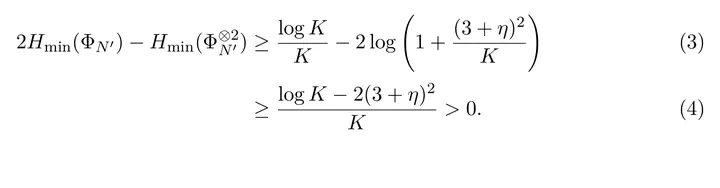 A deterministic lower bound on the entropy-additivity gap.
Abstract
We give a deterministic realization of the finite-dimensional quadratic certificate underlying Collins’s mixed-unitary proof of minimum-output-entropy nonadditivity. For every fixed integer $K\ge2$ and rational $\eta>0$ satisfying $\log K>2(3+\eta)^2$, a deterministic polynomial-time algorithm, for every sufficiently large target size $N$, outputs $K$ permutations on $N^{\prime}=N+o_{K,\eta}(N)$ points. Restricting their permutation matrices to the nontrivial standard representation yields real orthogonal Stinespring blocks and a channel $\Phi_{N^{\prime}}:M_{N^{\prime}-1}(\mathbb{C})\to M_K(\mathbb{C})$ such that
$$ \begin{aligned} &2H_{\min}(\Phi_{N^{\prime}}) -H_{\min}(\Phi_{N^{\prime}}^{\otimes2}) \\ &\quad\ge \frac{\log K}{K} -2\log\left(1+\frac{(3+\eta)^2}{K}\right) >0. \end{aligned} $$
The construction combines Haagerup’s length-two inequality with the simultaneous deterministic spectral approximation of O’Donnell and Wu.
We further show that the constant $3$ is asymptotically sharp on the relevant Hermitian zero-diagonal coefficient class and that the finite spectral transfer is nearly saturated, thereby isolating the finer geometry of the full output body as the natural next level of refinement beyond the scalar-radius method. Finally, a standard covariant extension converts the same deterministic entropy gap exactly into self-tensor superadditivity of the one-shot Holevo quantity.
Guocheng Zhen
PhD Student (2025)
I have received my bachelor's degree in mathematics from Wuhan University in 2022 and my master's degree in mathematics from Wuhan University in 2025. My main research is about probability theory, especially Large Random Dimension Matrices Theory. I am exploring the mathematical foundation in quantum information under the guidance of Prof. Xin Wang and Prof. Bartosz Regula.
Chengkai Zhu
PhD Graduate
Ranyiliu Chen
Visiting Scholar
I received my doctorate in Mathematics from the University of Copenhagen in 2025, under the supervision of Prof. Laura Mancinska. Previously I obtained my master’s and bachelor’s degrees in 2020 and 2017 respectively, both in electronic engineering from Beihang University. My research interests include quantum information theory, Bell non-locality and quantum machine learning.
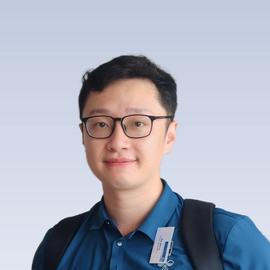
Xin Wang
Associate Professor
Prof. Xin Wang founded the QuAIR Lab at HKUST (Guangzhou) in June 2023. His research aims to advance our understanding of the limits of information processing with quantum systems and the potential of quantum artificial intelligence. His current interests include quantum algorithms, quantum resource theory, quantum machine learning, quantum computer architecture, and quantum error processing. Prior to establishing the QuAIR Lab, Prof. Wang was a Staff Researcher at the Institute for Quantum Computing at Baidu Research, where he focused on quantum computing research and the development of the Baidu Quantum Platform. Notably, he led the development of Paddle Quantum, a Python library for quantum machine learning. From 2018 to 2019, he was a Hartree Postdoctoral Fellow at the Joint Center for Quantum Information and Computer Science (QuICS) at the University of Maryland, College Park. Prof. Wang received his Ph.D. in quantum information from the University of Technology Sydney in 2018, under the supervision of Prof. Runyao Duan and Prof. Andreas Winter. He obtained his B.S. in mathematics (Wu Yuzhang Honors) from Sichuan University in 2014.