Almost One Bit Violation of Minimum-Output Rényi Entropy Additivity Simultaneously at All Orders
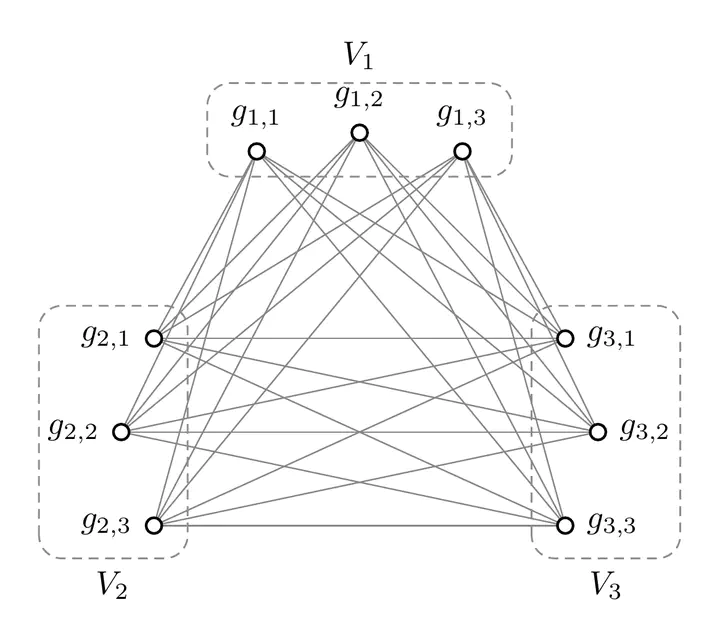 Commutation relations in the complete tripartite graph.
Abstract
We prove that minimum-output Rényi-entropy additivity can fail by almost one bit simultaneously at every nonnegative order. For every $\varepsilon\in(0,\log2)$, there exists a finite-dimensional quantum channel with a real Stinespring isometry such that the same maximally entangled input witnesses a tensor-square entropy gap of at least $\log2-\varepsilon$ for all $p\in[0,\infty]$. The output dimension can be chosen to be $O(\varepsilon^{-3})$ as $\varepsilon\downarrow0$.
The construction uses direct products of free groups: tensorized Haagerup estimates control the one-copy outputs, while commutation between distinct factors forces exact Bell-branch collisions at two copies. Strong convergence gives both an existential realization through finite-dimensional representations of right-angled Artin groups followed by realification, and a Haar-orthogonal model whose success probability tends to one as the matrix dimension grows. We also determine the exact Bell quotient, prove asymptotically sharp regular-radius bounds, and show that the cubic output-dimension scale is optimal within the present purity–rank certificate.
Guocheng Zhen
PhD Student (2025)
I have received my bachelor's degree in mathematics from Wuhan University in 2022 and my master's degree in mathematics from Wuhan University in 2025. My main research is about probability theory, especially Large Random Dimension Matrices Theory. I am exploring the mathematical foundation in quantum information under the guidance of Prof. Xin Wang and Prof. Bartosz Regula.

Chengkai Zhu
PhD Graduate

Ranyiliu Chen
Visiting Scholar
I received my doctorate in Mathematics from the University of Copenhagen in 2025, under the supervision of Prof. Laura Mancinska. Previously I obtained my master’s and bachelor’s degrees in 2020 and 2017 respectively, both in electronic engineering from Beihang University. My research interests include quantum information theory, Bell non-locality and quantum machine learning.

Xin Wang
Associate Professor
Prof. Xin Wang founded the QuAIR Lab at HKUST (Guangzhou) in June 2023. His research aims to advance our understanding of the limits of information processing with quantum systems and the potential of quantum artificial intelligence. His current interests include quantum algorithms, quantum resource theory, quantum machine learning, quantum computer architecture, and quantum error processing. Prior to establishing the QuAIR Lab, Prof. Wang was a Staff Researcher at the Institute for Quantum Computing at Baidu Research, where he focused on quantum computing research and the development of the Baidu Quantum Platform. Notably, he led the development of Paddle Quantum, a Python library for quantum machine learning. From 2018 to 2019, he was a Hartree Postdoctoral Fellow at the Joint Center for Quantum Information and Computer Science (QuICS) at the University of Maryland, College Park. Prof. Wang received his Ph.D. in quantum information from the University of Technology Sydney in 2018, under the supervision of Prof. Runyao Duan and Prof. Andreas Winter. He obtained his B.S. in mathematics (Wu Yuzhang Honors) from Sichuan University in 2014.