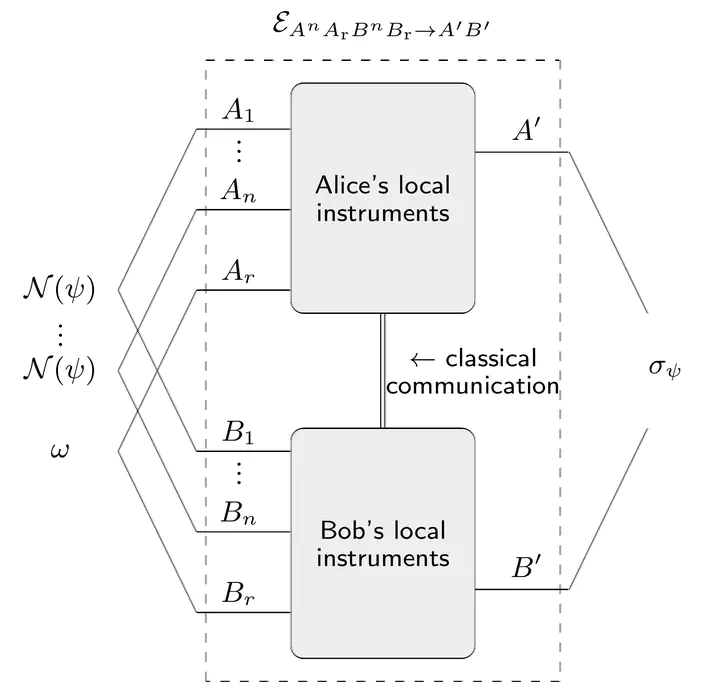
 Distributed purification with a preshared resource state.
Abstract
We determine the preshared entanglement required for spatially separated parties, restricted to local operations and classical communication, to attain globally optimal probabilistic two-copy purification of arbitrary bipartite pure states under depolarizing noise. In every local dimension $d\ge 2$, one shared maximally entangled qubit pair suffices: local controlled-SWAP operations exactly reproduce the globally optimal successful transformation. Conversely, any finite-dimensional preshared resource state that attains the same benchmark, even under a positive-partial-transpose relaxation, must have entanglement of formation at least one ebit. For pure resources with one ebit, or for two-qubit resources including mixed states, attaining the benchmark is possible only for states with exactly two nonzero Schmidt weights, both equal to $1/2$, namely those locally unitarily equivalent to a maximally entangled qubit pair. These findings provide a benchmark for evaluating the entanglement demands of noise management in quantum networks and modular quantum computers.
Jiayi Zhao
PhD Student (co, 2025)
I obtained my BS in Mathematics and Applied Mathematics from Jilin University under the supervision of Prof. Sen Zhu. I obtained my MS degree in Applied Mathematics from Zhejiang University under the supervision of Prof. Junde Wu. My research interests include quantum information theory, quantum computation and computational complexity.
Chengkai Zhu
PhD Graduate
Xin Wang
Associate Professor
Prof. Xin Wang founded the QuAIR Lab at HKUST (Guangzhou) in June 2023. His research aims to advance our understanding of the limits of information processing with quantum systems and the potential of quantum artificial intelligence. His current interests include quantum algorithms, quantum resource theory, quantum machine learning, quantum computer architecture, and quantum error processing. Prior to establishing the QuAIR Lab, Prof. Wang was a Staff Researcher at the Institute for Quantum Computing at Baidu Research, where he focused on quantum computing research and the development of the Baidu Quantum Platform. Notably, he led the development of Paddle Quantum, a Python library for quantum machine learning. From 2018 to 2019, he was a Hartree Postdoctoral Fellow at the Joint Center for Quantum Information and Computer Science (QuICS) at the University of Maryland, College Park. Prof. Wang received his Ph.D. in quantum information from the University of Technology Sydney in 2018, under the supervision of Prof. Runyao Duan and Prof. Andreas Winter. He obtained his B.S. in mathematics (Wu Yuzhang Honors) from Sichuan University in 2014.