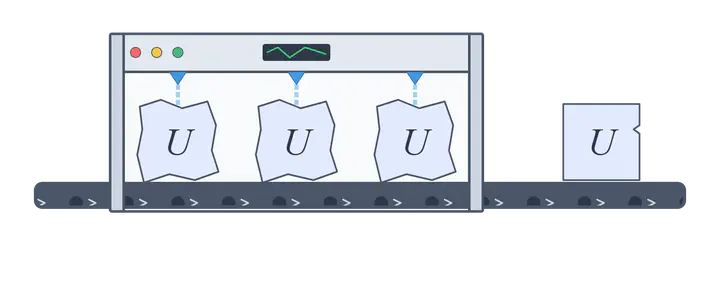
 Illustration of unitary purification.
Abstract
Quantum gates executed on physical hardware are inevitably degraded by environmental noise. While state purification effectively distills static quantum resources, the dynamic execution of quantum algorithms requires a higher-order approach to mitigate errors on the operations themselves. In this work, we investigate unitary purification: the task of utilizing a quantum higher-order operation to partially restore the ideal action of an unknown unitary corrupted by a known noise model. Focusing on canonical depolarizing noise, we first reveal a fundamental operational obstruction. We prove that within the indefinite causal order framework, no nontrivial 2-slot higher-order operation can universally purify the set of single-qubit unitaries. Overcoming this strict limitation, we establish that a 3-slot architecture provides the minimal realization for non-trivial universal purification. We analytically derive the optimal average fidelity for the 3-slot regime, demonstrating that it strictly surpasses trivial strategies by systematically utilizing ancillary qubits as a quantum memory to absorb errors. Furthermore, we provide a concrete quantum circuit construction for this optimal higher-order operation. Our results establish the strict theoretical boundaries of distilling clean operations from noisy gates, offering immediate architectural insights for robust gate design.
Jiayi Zhao
PhD Student (co, 2025)
I obtained my BS in Mathematics and Applied Mathematics from Jilin University under the supervision of Prof. Sen Zhu. I obtained my MS degree in Applied Mathematics from Zhejiang University under the supervision of Prof. Junde Wu. My research interests include quantum information theory, quantum computation and computational complexity.
Yu-Ao Chen
Visiting Scholar
I obtained my BS in Mathematics and Applied Mathematics from University of Science and Technology of China. I obtained my PhD degree in Applied Mathematics from University of Chinese Academy of Sciences under the supervision of Prof. Xiao-Shan Gao. My research interests include quantum computing, symbolic computation and cryptanalysis.
Guocheng Zhen
PhD Student (2025)
I have received my bachelor's degree in mathematics from Wuhan University in 2022 and my master's degree in mathematics from Wuhan University in 2025. My main research is about probability theory, especially Large Random Dimension Matrices Theory. I am exploring the mathematical foundation in quantum information under the guidance of Prof. Xin Wang and Prof. Bartosz Regula.
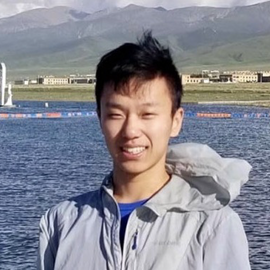
Chengkai Zhu
PhD Graduate
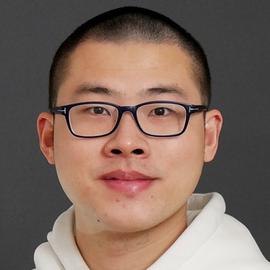
Ranyiliu Chen
Visiting Scholar
I received my doctorate in Mathematics from the University of Copenhagen in 2025, under the supervision of Prof. Laura Mancinska. Previously I obtained my master’s and bachelor’s degrees in 2020 and 2017 respectively, both in electronic engineering from Beihang University. My research interests include quantum information theory, Bell non-locality and quantum machine learning.
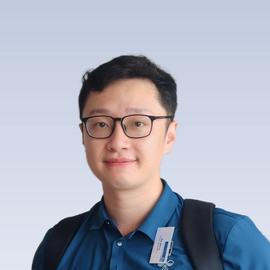
Xin Wang
Associate Professor
Prof. Xin Wang founded the QuAIR Lab at HKUST (Guangzhou) in June 2023. His research aims to advance our understanding of the limits of information processing with quantum systems and the potential of quantum artificial intelligence. His current interests include quantum algorithms, quantum resource theory, quantum machine learning, quantum computer architecture, and quantum error processing. Prior to establishing the QuAIR Lab, Prof. Wang was a Staff Researcher at the Institute for Quantum Computing at Baidu Research, where he focused on quantum computing research and the development of the Baidu Quantum Platform. Notably, he led the development of Paddle Quantum, a Python library for quantum machine learning. From 2018 to 2019, he was a Hartree Postdoctoral Fellow at the Joint Center for Quantum Information and Computer Science (QuICS) at the University of Maryland, College Park. Prof. Wang received his Ph.D. in quantum information from the University of Technology Sydney in 2018, under the supervision of Prof. Runyao Duan and Prof. Andreas Winter. He obtained his B.S. in mathematics (Wu Yuzhang Honors) from Sichuan University in 2014.