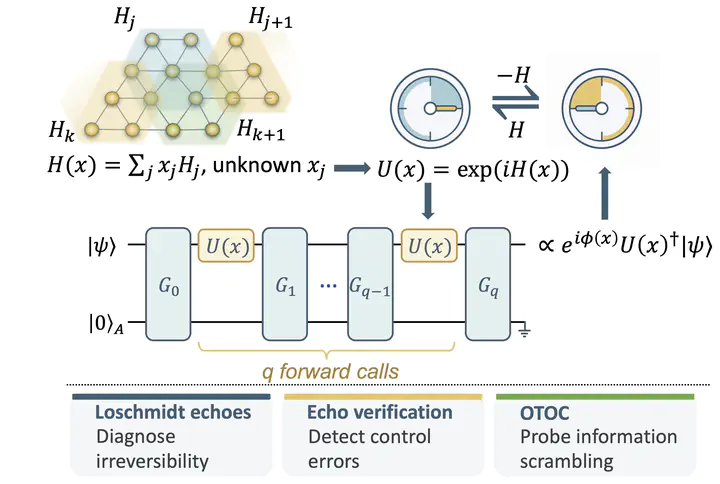
 Structure-aware Hamiltonian inversion from repeated forward calls.
Abstract
Deterministic exact inversion of an arbitrary d-dimensional unitary requires $\Theta(d^2)$ coherent forward calls in the worst case. We ask how this cost changes for Hamiltonian evolution $U(x)=\exp(i \sum_j x_j H_j)$ when the generators are known but the parameters are hidden. For one-parameter families with a fixed eigenbasis, we show that additive relations among the distinct eigenvalues determine the optimal query number exactly, and we construct the corresponding inversion protocol. For general families, we prove that repeated symmetry sectors do not affect the exact query complexity and give an automatic construction for combining inverses from inequivalent active sectors. We also give a sufficient phase-alignment condition under which family-specific structure can reduce the query number. These results establish structure-dependent bounds for reversing the unknown dynamics arising in Tavis-Cummings out-of-time-order correlator protocols, collective-spin echo verification, and passive multimode links, without requiring prior knowledge or explicit estimation of the underlying coupling strengths.
Jizhe Lai
PhD Student (2025)
I obtained my BS in Physics from SUN YAT-SEN University under the supervision of Prof. Yiwen Pan. I obtained my MS degree in Imperial College London under the supervision of Prof. Chris Hull, FRS. My research interests include mathematical physics and quantum computation.
Mingrui Jing
PhD Student (2023)
I obtained my BS and MS degrees in physics from the University of Melbourne. My research interests include distributed quantum computing, quantum entanglement and quantum machine learning.
Erdong Huang
PhD Student (2024)
I obtained my BS in Applied Physics from Beijing Institute of Technology, Zhuhai (BITZ). I obtained my MSc degree in Physics from The Chinese University of Hong Kong. My research interests include quantum hardware, quantum information theory and quantum computing.
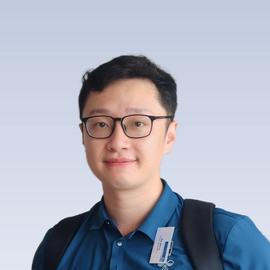
Xin Wang
Associate Professor
Prof. Xin Wang founded the QuAIR Lab at HKUST (Guangzhou) in June 2023. His research aims to advance our understanding of the limits of information processing with quantum systems and the potential of quantum artificial intelligence. His current interests include quantum algorithms, quantum resource theory, quantum machine learning, quantum computer architecture, and quantum error processing. Prior to establishing the QuAIR Lab, Prof. Wang was a Staff Researcher at the Institute for Quantum Computing at Baidu Research, where he focused on quantum computing research and the development of the Baidu Quantum Platform. Notably, he led the development of Paddle Quantum, a Python library for quantum machine learning. From 2018 to 2019, he was a Hartree Postdoctoral Fellow at the Joint Center for Quantum Information and Computer Science (QuICS) at the University of Maryland, College Park. Prof. Wang received his Ph.D. in quantum information from the University of Technology Sydney in 2018, under the supervision of Prof. Runyao Duan and Prof. Andreas Winter. He obtained his B.S. in mathematics (Wu Yuzhang Honors) from Sichuan University in 2014.