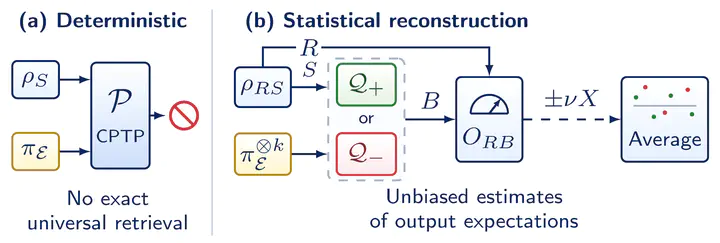
 Exact virtual channel programming.
Abstract
A finite-dimensional physical processor cannot exactly program a continuous family of distinct unitary channels. We show that this obstruction becomes quantitative when the target channel is stored in a normalized Choi state and its output observables are reconstructed by sampling physical channels and classically post-processing their measurement outcomes. For arbitrary d-dimensional channels, we construct a target-independent exact reconstruction protocol and prove the optimal one-copy sampling overhead, which grows quadratically with system dimension. We further prove the sharp fixed-d law that the excess overhead vanishes inversely with the number of identical Choi programs. The upper bound combines deterministic port-based teleportation with a quasi-decomposition that corrects its depolarizing distortion. The converse maps any low-overhead reconstruction protocol to a physical learner of unknown unitaries and uses local quantum estimation to recover the same leading coefficient. These results recast the universal no-programming obstruction as a quantitative trade-off between quantum program memory and classical sampling, with a leading cost that reflects the locally learnable unitary degrees of freedom.
Mingrui Jing
PhD Student (2023)
I obtained my BS and MS degrees in physics from the University of Melbourne. My research interests include distributed quantum computing, quantum entanglement and quantum machine learning.
Mengbo Guo
PhD Student (2026)
I obtained my BS in Physics from Wuhan University. I obtained my MS degree in Physics from Hong Kong University of Science and Technology under the supervision of Prof. Gyu-boong Jo. My research interests include quantum computation and AI for materials.
Hongshun Yao
PhD Student (2024)
I obtained my BS degree in Mathematics from Nanjing University of Aeronautics and Astronautics and my MS degree in Mathematics from Beihang University. My research interests include quantum information theory and quantum machine learning.
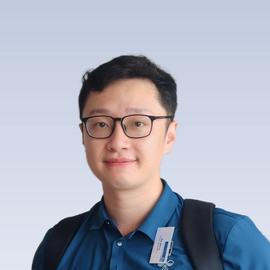
Xin Wang
Associate Professor
Prof. Xin Wang founded the QuAIR Lab at HKUST (Guangzhou) in June 2023. His research aims to advance our understanding of the limits of information processing with quantum systems and the potential of quantum artificial intelligence. His current interests include quantum algorithms, quantum resource theory, quantum machine learning, quantum computer architecture, and quantum error processing. Prior to establishing the QuAIR Lab, Prof. Wang was a Staff Researcher at the Institute for Quantum Computing at Baidu Research, where he focused on quantum computing research and the development of the Baidu Quantum Platform. Notably, he led the development of Paddle Quantum, a Python library for quantum machine learning. From 2018 to 2019, he was a Hartree Postdoctoral Fellow at the Joint Center for Quantum Information and Computer Science (QuICS) at the University of Maryland, College Park. Prof. Wang received his Ph.D. in quantum information from the University of Technology Sydney in 2018, under the supervision of Prof. Runyao Duan and Prof. Andreas Winter. He obtained his B.S. in mathematics (Wu Yuzhang Honors) from Sichuan University in 2014.