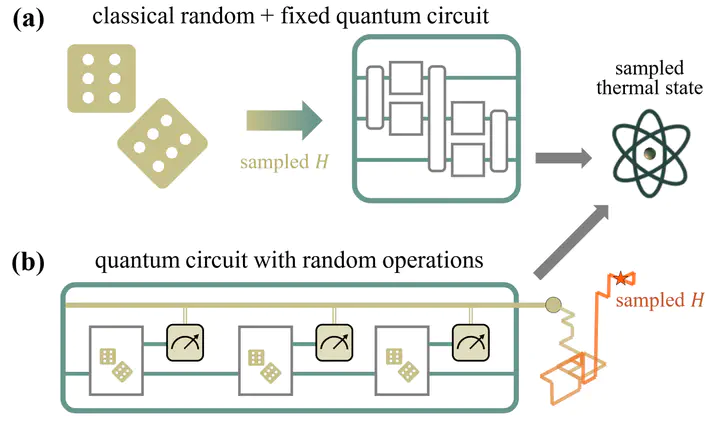
 Idea of quantum measurement-controlled sampling.
Abstract
Thermal equilibrium states of many-body Hamiltonians are essential for probing quantum chaos, finite-temperature phases of matter, and training quantum machine learning models, yet generating large collections of such states across different Hamiltonians remains costly with existing methods. We introduce a powerful operation, the quantum thermal-drift channel, to construct a measurement-controlled sampling algorithm that autonomously generates thermal states together with their system Hamiltonians as labels for general physical models. We prove that our algorithm is efficient: the total gate count scales polynomially with system size and quadratically with inverse temperature, providing the first polynomial resource bound for random thermal state generation. We characterize the distribution of sampled Hamiltonians as a normal distribution reweighted by partition functions, which quantifies a trade-off between sampling accuracy and effective label range. Level-spacing statistics computed from sampled thermal states of a 2D transverse-field Ising model show a crossover to Wigner-Dyson universality, confirming that the sampler captures nontrivial chaotic correlations. Finally, a variational quantum classifier trained on the generated dataset achieves near-optimal accuracy in predicting Hamiltonian properties of unseen states. These results establish a scalable, quantum-native route for thermodynamic simulation and labeled quantum data generation in many-body systems.
Jiyu Jiang
Research Assistant
I obtained my BS in Applied Mathematics from New York University, Shanghai. I am about to obtain my MS degree in Statistics from Fudan University under the supervision of Prof. Meiyue Shao. My research interests include quantum computing, quantum information and artificial intelligence.
Mingrui Jing
PhD Student (2023)
I obtained my BS and MS degrees in physics from the University of Melbourne. My research interests include distributed quantum computing, quantum entanglement and quantum machine learning.
Jizhe Lai
PhD Student (2025)
I obtained my BS in Physics from SUN YAT-SEN University under the supervision of Prof. Yiwen Pan. I obtained my MS degree in Imperial College London under the supervision of Prof. Chris Hull, FRS. My research interests include mathematical physics and quantum computation.
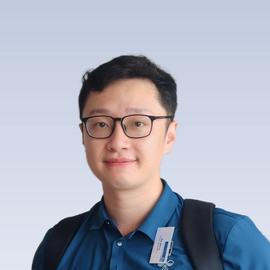
Xin Wang
Associate Professor
Prof. Xin Wang founded the QuAIR Lab at HKUST (Guangzhou) in June 2023. His research aims to advance our understanding of the limits of information processing with quantum systems and the potential of quantum artificial intelligence. His current interests include quantum algorithms, quantum resource theory, quantum machine learning, quantum computer architecture, and quantum error processing. Prior to establishing the QuAIR Lab, Prof. Wang was a Staff Researcher at the Institute for Quantum Computing at Baidu Research, where he focused on quantum computing research and the development of the Baidu Quantum Platform. Notably, he led the development of Paddle Quantum, a Python library for quantum machine learning. From 2018 to 2019, he was a Hartree Postdoctoral Fellow at the Joint Center for Quantum Information and Computer Science (QuICS) at the University of Maryland, College Park. Prof. Wang received his Ph.D. in quantum information from the University of Technology Sydney in 2018, under the supervision of Prof. Runyao Duan and Prof. Andreas Winter. He obtained his B.S. in mathematics (Wu Yuzhang Honors) from Sichuan University in 2014.
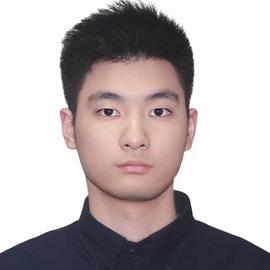
Lei Zhang
PhD Student (2023)
I obtained my BMath in AMath, CO & joint PMath from the University of Waterloo. My research interests include quantum algorithm design and quantum machine learning.