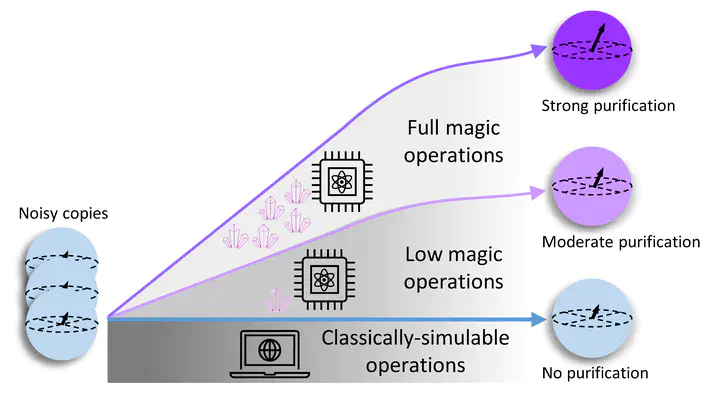
 Role of magic in universal quantum state purification.
Abstract
Quantum state purification aims to recover higher-fidelity quantum states from multiple noisy copies and is a fundamental primitive for quantum information processing. Magic resources enable operations beyond classically simulable dynamics and are central to universal fault-tolerant quantum computation. Recent no-go results show that classically simulable operations cannot achieve a nontrivial universal fidelity gain. This motivates a quantitative theory of the magic required for purification at prescribed success probability and target fidelity. For universal purification with two input copies, we prove an exact linear mana law in odd dimensions and a two-sided linear robustness law for multi-qubit systems, which becomes exact for a single qubit. We also identify an explicit successful purification map that makes the tradeoff transparent. These results establish universal purification as a task obeying a quantitative magic-fidelity law and link magic resources to error mitigation and fault-tolerant quantum information processing.
Keming He
PhD Student (2024)
I obtained my BS in Electronic Information Science and Technology from Chongqing University. I obtained my MS degree in Electrical Engineering from University of Southern California. My research interests include quantum information theory and quantum error correction.
Enji Xiong
Undergraduate Student
I am studying at The Hong Kong University of Science and Technology (Guangzhou). My research interests include quantum information theory and quantum computation.
Xin Wang
Associate Professor
Prof. Xin Wang founded the QuAIR Lab at HKUST (Guangzhou) in June 2023. His research aims to advance our understanding of the limits of information processing with quantum systems and the potential of quantum artificial intelligence. His current interests include quantum algorithms, quantum resource theory, quantum machine learning, quantum computer architecture, and quantum error processing. Prior to establishing the QuAIR Lab, Prof. Wang was a Staff Researcher at the Institute for Quantum Computing at Baidu Research, where he focused on quantum computing research and the development of the Baidu Quantum Platform. Notably, he led the development of Paddle Quantum, a Python library for quantum machine learning. From 2018 to 2019, he was a Hartree Postdoctoral Fellow at the Joint Center for Quantum Information and Computer Science (QuICS) at the University of Maryland, College Park. Prof. Wang received his Ph.D. in quantum information from the University of Technology Sydney in 2018, under the supervision of Prof. Runyao Duan and Prof. Andreas Winter. He obtained his B.S. in mathematics (Wu Yuzhang Honors) from Sichuan University in 2014.