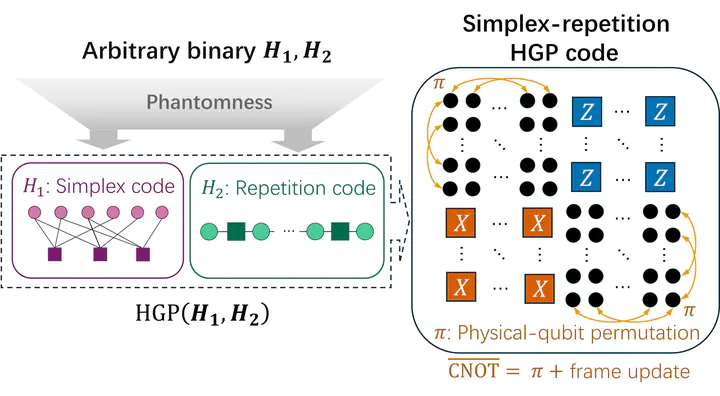
 The simplex-repetition HGP phantom code
Abstract
Logical entangling gates are a major source of physical spacetime overhead in fault-tolerant quantum computation. Phantom codes reduce this cost by implementing every ordered in-block logical CNOT through physical qubit permutations and Pauli-frame updates. Whether this mechanism can coexist with the low-weight stabilizer structure of qLDPC codes is a central question for low-overhead fault-tolerant architectures. We give a deterministic answer within binary CSS hypergraph product (HGP) codes. Up to natural equivalences, the simplex-repetition family is the unique HGP family satisfying the phantom condition. We then evaluate this family under circuit-level noise in logical GHZ-state preparation and Trotterized many-body quantum simulation. The codes retain low-weight stabilizer checks and yield concrete advantages over rotated surface-code baselines in both benchmarks. Reconfigurable neutral-atom arrays offer a natural setting for this approach, supporting nonlocal qLDPC operations while enabling in-block logical CNOTs without additional physical operations. Together, these results make precise how permutation-based logical entangling constrains code design within the HGP framework, demonstrate the circuit-level benefits of the unique family, and guide the search for phantom qLDPC families with better asymptotic parameters for low-overhead fault tolerance on neutral-atom hardware.

Keming He
PhD Student (2024)
I obtained my BS in Electronic Information Science and Technology from Chongqing University. I obtained my MS degree in Electrical Engineering from University of Southern California. My research interests include quantum information theory and quantum error correction.

Ziao Tang
PhD Student (co, 2025)
I obtained my BSc in Mathematics from the University of Hong Kong. My research interests include quantum information and quantum computing.

Zetong Li
Research Associate
I expect to obtain my PhD degree from Southeast University under the supervision of Prof. Xu-Tao Yu. My research interests include quantum information, quantum characterization, verification, and validation (QCVV), and quantum comb.

Xin Wang
Associate Professor
Prof. Xin Wang founded the QuAIR Lab at HKUST (Guangzhou) in June 2023. His research aims to advance our understanding of the limits of information processing with quantum systems and the potential of quantum artificial intelligence. His current interests include quantum algorithms, quantum resource theory, quantum machine learning, quantum computer architecture, and quantum error processing. Prior to establishing the QuAIR Lab, Prof. Wang was a Staff Researcher at the Institute for Quantum Computing at Baidu Research, where he focused on quantum computing research and the development of the Baidu Quantum Platform. Notably, he led the development of Paddle Quantum, a Python library for quantum machine learning. From 2018 to 2019, he was a Hartree Postdoctoral Fellow at the Joint Center for Quantum Information and Computer Science (QuICS) at the University of Maryland, College Park. Prof. Wang received his Ph.D. in quantum information from the University of Technology Sydney in 2018, under the supervision of Prof. Runyao Duan and Prof. Andreas Winter. He obtained his B.S. in mathematics (Wu Yuzhang Honors) from Sichuan University in 2014.