Block Coordinate Descent for Dynamic Portfolio Optimization on Finite-Precision Coherent Ising Machines
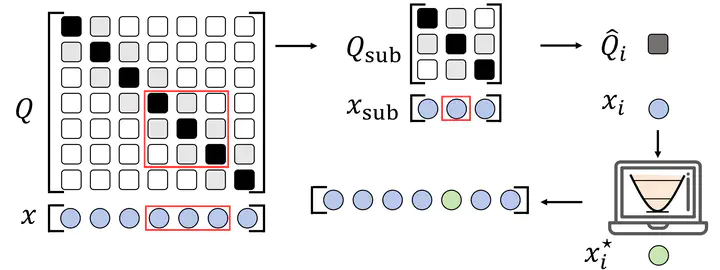 The Illustration of Block coordinate descent.
Abstract
Coherent Ising machines (CIMs) have emerged as specialized quantum hardware for large-scale combinatorial optimization. However, for large instances that remain challenging for classical methods, some platforms support only finite-precision inputs, and the required scaling and quantization can degrade solution quality. Dynamic portfolio optimization (DPO) can be formulated as a quadratic unconstrained binary optimization (QUBO) problem, but large instances are especially vulnerable to precision loss under global scaling. We propose a block coordinate descent method that decomposes the DPO model along the time dimension and iteratively solves compact time-block subproblems on the device. Experiments on finite-precision CIM hardware show that the method enables these instances to be solved under hardware precision limits, yields portfolios competitive with classical benchmark solvers, and reduces runtime through fast CIM solution of the resulting subproblems. These results demonstrate the promise of finite-precision CIMs as a practical and scalable approach to structured large-scale combinatorial optimization.
Keming He
PhD Student (2024)
I obtained my BS in Electronic Information Science and Technology from Chongqing University. I obtained my MS degree in Electrical Engineering from University of Southern California. My research interests include quantum information theory and quantum error correction.
Yuehan Zhang
Research Assistant
I am currently pursuing my BE in Cyber Science And Engineering at Sichuan University, where I enrolled in September 2023. My research interests include Quantum Information Theory, Artificial Intelligence, and Quantum Computing.
Hongshun Yao
PhD Student (2024)
I obtained my BS degree in Mathematics from Nanjing University of Aeronautics and Astronautics and my MS degree in Mathematics from Beihang University. My research interests include quantum information theory and quantum machine learning.
Xin Wang
Associate Professor
Prof. Xin Wang founded the QuAIR Lab at HKUST (Guangzhou) in June 2023. His research aims to advance our understanding of the limits of information processing with quantum systems and the potential of quantum artificial intelligence. His current interests include quantum algorithms, quantum resource theory, quantum machine learning, quantum computer architecture, and quantum error processing. Prior to establishing the QuAIR Lab, Prof. Wang was a Staff Researcher at the Institute for Quantum Computing at Baidu Research, where he focused on quantum computing research and the development of the Baidu Quantum Platform. Notably, he led the development of Paddle Quantum, a Python library for quantum machine learning. From 2018 to 2019, he was a Hartree Postdoctoral Fellow at the Joint Center for Quantum Information and Computer Science (QuICS) at the University of Maryland, College Park. Prof. Wang received his Ph.D. in quantum information from the University of Technology Sydney in 2018, under the supervision of Prof. Runyao Duan and Prof. Andreas Winter. He obtained his B.S. in mathematics (Wu Yuzhang Honors) from Sichuan University in 2014.