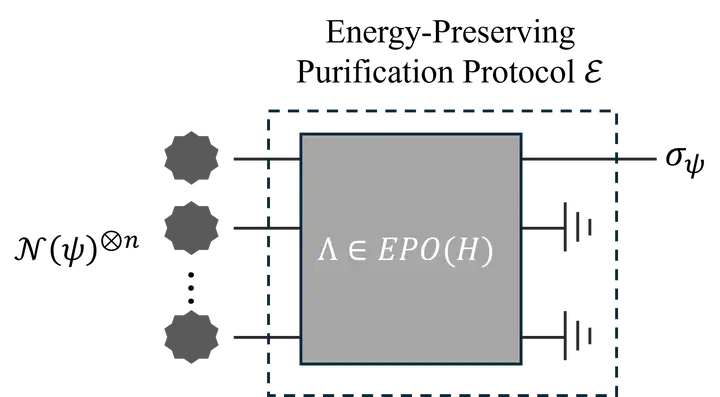
 The quantum state purification protocol
Abstract
Quantum state purification, which operates not by identifying and correcting specific errors but by repeatedly projecting multiple noisy copies onto special subspaces, provides a syndrome-free alternative to quantum error correction. Existing purification protocols, however, generally assume unconstrained operations and thus overlook the energetic restrictions inherent in realistic quantum devices. Here, we establish a general framework for universal state purification under energy-conservation constraints for depolarizing noise. We derive a necessary and sufficient condition for the nonexistence of universal energy-preserving purification and, whenever such purification is feasible, analytically determine the optimal performance and the corresponding protocols. We further show how the optimal protocols can be systematically implemented using only energy-preserving operations. Numerical results confirm the effectiveness of the proposed scheme. Our framework recovers the standard purification setting as a special case and naturally extends to scenarios assisted by external energy resources. These results identify fundamental physical limits on state distillation and provide an energy-efficient route to quantum error mitigation.
Xingchen Guo
Alumni
Benchi Zhao
Visiting Scholar
I obtained my MS degree in Physics from Imperial College London. I was an intern at Baidu Research under the supervision of Prof. Xin Wang. I obtained my PhD degree in quantum information at Osaka University. My research interests include quantum error mitigation, quantum information theory and quantum computation.
Xin Wang
Associate Professor
Prof. Xin Wang founded the QuAIR Lab at HKUST (Guangzhou) in June 2023. His research aims to advance our understanding of the limits of information processing with quantum systems and the potential of quantum artificial intelligence. His current interests include quantum algorithms, quantum resource theory, quantum machine learning, quantum computer architecture, and quantum error processing. Prior to establishing the QuAIR Lab, Prof. Wang was a Staff Researcher at the Institute for Quantum Computing at Baidu Research, where he focused on quantum computing research and the development of the Baidu Quantum Platform. Notably, he led the development of Paddle Quantum, a Python library for quantum machine learning. From 2018 to 2019, he was a Hartree Postdoctoral Fellow at the Joint Center for Quantum Information and Computer Science (QuICS) at the University of Maryland, College Park. Prof. Wang received his Ph.D. in quantum information from the University of Technology Sydney in 2018, under the supervision of Prof. Runyao Duan and Prof. Andreas Winter. He obtained his B.S. in mathematics (Wu Yuzhang Honors) from Sichuan University in 2014.