Triage: An Adaptive Parallel Window Decoding Scheduler for Real-Time Fault-Tolerant Quantum Computation
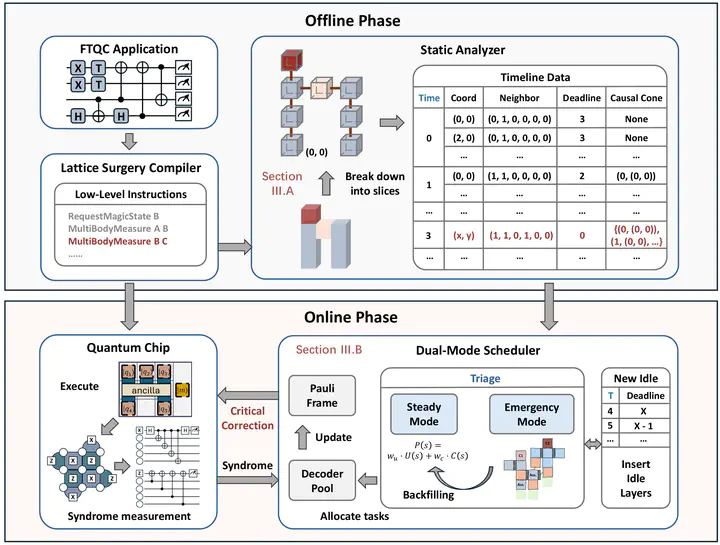 Overview of the Triage framework
Abstract
Fault-tolerant quantum computation (FTQC) critically depends on real-time classical decoding, which is rapidly emerging as a system bottleneck. As quantum systems scale, decoding latency and throughput limitations lead to exponential syndrome backlogs and logical operation stalls. While hardware accelerators and parallel windowing offer pathways to speed up decoding, dynamically deploying a finite pool of decoders across a vast quantum error correction architecture remains an unresolved resource allocation problem. To address this, we formulate FTQC decoding as a constrained dynamic scheduling problem by utilizing a spatio-temporal framework based on slices. We propose Triage, a dual-mode architecture that mitigates operation stalls by adaptively combining a cost-efficient heuristic scheduler with a priority-aware emergency mode to rapidly resolve the causal cone of critical operations. Our evaluation shows that Triage maintains low algorithm stalls and logical error rates even under scarce classical resource constraints. Across various benchmarks, Triage achieves an average logical error rate reduction of 52.6% compared to standard temporal parallelism, enabling an efficient classical control plane for scalable FTQC architectures.
Jiahan Chen
PhD Student (2025)
I obtained my BS in Computer Science and Technology from Xi’an Jiaotong University. I obtained my MS degree in Computer Science and Technology from Harbin Institute of Technology, Shenzhen. My research interests include quantum information theory and quantum error correction.

Chenghong Zhu
PhD Student (2023)
I obtained my BS and MS degrees in computer science from the University of Melbourne. My research interests include distributed quantum computing, quantum entanglement and quantum machine learning.
Xin Wang
Associate Professor
Prof. Xin Wang founded the QuAIR Lab at HKUST (Guangzhou) in June 2023. His research aims to advance our understanding of the limits of information processing with quantum systems and the potential of quantum artificial intelligence. His current interests include quantum algorithms, quantum resource theory, quantum machine learning, quantum computer architecture, and quantum error processing. Prior to establishing the QuAIR Lab, Prof. Wang was a Staff Researcher at the Institute for Quantum Computing at Baidu Research, where he focused on quantum computing research and the development of the Baidu Quantum Platform. Notably, he led the development of Paddle Quantum, a Python library for quantum machine learning. From 2018 to 2019, he was a Hartree Postdoctoral Fellow at the Joint Center for Quantum Information and Computer Science (QuICS) at the University of Maryland, College Park. Prof. Wang received his Ph.D. in quantum information from the University of Technology Sydney in 2018, under the supervision of Prof. Runyao Duan and Prof. Andreas Winter. He obtained his B.S. in mathematics (Wu Yuzhang Honors) from Sichuan University in 2014.