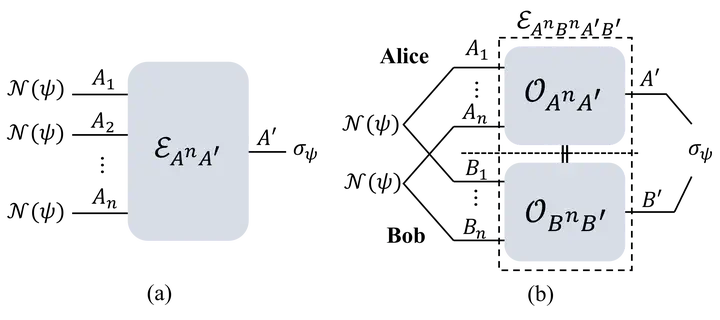
 Diagram of purification protocol.
Abstract
Quantum state purification protocols, which mitigate noise by converting multiple copies of noisy quantum states into fewer copies with a lower noise level, have applications in quantum communication and computation with imperfect devices. Here, we systematically study the task of state purification in distributed quantum systems, demanding that purification be achieved by local operations and classical communication (LOCC). We prove that, in the presence of depolarizing noise, no LOCC purification protocol starting from two copies can work blindly for all the states in three important sets: the set of all pure two-qubit states, the set of all two-qubit maximally entangled states, and the Bell basis. In stark contrast, we show that a targeted, single-state purification is always achievable in the presence of depolarizing noise, and we provide an explicit analytical LOCC protocol for every given two-qubit state. For arbitrary finite sets of pure states and arbitrary noise profiles, we develop an optimization-based algorithm that systematically designs LOCC purification protocols, and we demonstrate it through concrete examples. Overall, our results identify both fundamental limitations and practical noise-reduction strategies for distributed quantum information processing.
Benchi Zhao
Visiting Scholar
I obtained my MS degree in Physics from Imperial College London. I was an intern at Baidu Research under the supervision of Prof. Xin Wang. I obtained my PhD degree in quantum information at Osaka University. My research interests include quantum error mitigation, quantum information theory and quantum computation.
Yu-Ao Chen
Visiting Scholar
I obtained my BS in Mathematics and Applied Mathematics from University of Science and Technology of China. I obtained my PhD degree in Applied Mathematics from University of Chinese Academy of Sciences under the supervision of Prof. Xiao-Shan Gao. My research interests include quantum computing, symbolic computation and cryptanalysis.

Chengkai Zhu
PhD Student (2023)
I obtained my BS in Applied Mathematics from China Agricultural University under the supervision of Prof. Zhencai Shen. I obtained my MS degree in Cyberspace Security from University of Chinese Academy of Sciences under the supervision of Prof. Zhenyu Huang. My research interests include quantum information theory and quantum computation.

Xin Wang
Associate Professor
Prof. Xin Wang founded the QuAIR Lab at HKUST (Guangzhou) in June 2023. His research aims to advance our understanding of the limits of information processing with quantum systems and the potential of quantum artificial intelligence. His current interests include quantum algorithms, quantum resource theory, quantum machine learning, quantum computer architecture, and quantum error processing. Prior to establishing the QuAIR Lab, Prof. Wang was a Staff Researcher at the Institute for Quantum Computing at Baidu Research, where he focused on quantum computing research and the development of the Baidu Quantum Platform. Notably, he led the development of Paddle Quantum, a Python library for quantum machine learning. From 2018 to 2019, he was a Hartree Postdoctoral Fellow at the Joint Center for Quantum Information and Computer Science (QuICS) at the University of Maryland, College Park. Prof. Wang received his Ph.D. in quantum information from the University of Technology Sydney in 2018, under the supervision of Prof. Runyao Duan and Prof. Andreas Winter. He obtained his B.S. in mathematics (Wu Yuzhang Honors) from Sichuan University in 2014.