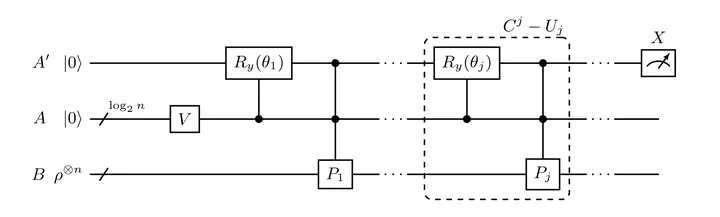
 The quantum state function (QSF) framework
Abstract
Estimating nonlinear functions of quantum states is essential for quantum information processing tasks such as entropy quantification, fidelity estimation, and entanglement spectroscopy. Existing approaches based on quantum state tomography incur exponential resource overhead, while methods relying on purified query access impose significant practical constraints. Here, we introduce the quantum state function framework, which extends the swap test via a linear combination of unitaries and parameterized quantum circuits. The framework estimates any normalized degree-n polynomial function of a quantum state with precision ε using O(n/ε²) copies, operating directly on identical copies without block-encoding or purified queries. Applied to von Neumann entropy, quantum relative entropy, and state fidelity, it achieves sample complexity O ̃(γ²/(ε²κ)), where κ is the minimal nonzero eigenvalue and γ a normalization factor. This framework establishes a unified paradigm for nonlinear quantum state processing, broadening the toolkit for practical quantum data analysis.
Hongshun Yao
PhD Student (2024)
I obtained my BS degree in Mathematics from Nanjing University of Aeronautics and Astronautics and my MS degree in Mathematics from Beihang University. My research interests include quantum information theory and quantum machine learning.
Yingjian Liu
Alumni
Tengxiang Lin
PhD Student (co, 2025)
I obtained my B.E. in Information Engineering from South China University of Technology. My research interests include quantum information theory and quantum computation.
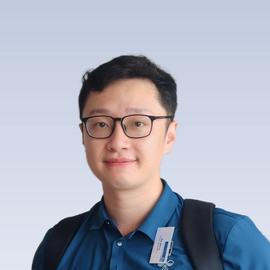
Xin Wang
Associate Professor
Prof. Xin Wang founded the QuAIR Lab at HKUST (Guangzhou) in June 2023. His research aims to advance our understanding of the limits of information processing with quantum systems and the potential of quantum artificial intelligence. His current interests include quantum algorithms, quantum resource theory, quantum machine learning, quantum computer architecture, and quantum error processing. Prior to establishing the QuAIR Lab, Prof. Wang was a Staff Researcher at the Institute for Quantum Computing at Baidu Research, where he focused on quantum computing research and the development of the Baidu Quantum Platform. Notably, he led the development of Paddle Quantum, a Python library for quantum machine learning. From 2018 to 2019, he was a Hartree Postdoctoral Fellow at the Joint Center for Quantum Information and Computer Science (QuICS) at the University of Maryland, College Park. Prof. Wang received his Ph.D. in quantum information from the University of Technology Sydney in 2018, under the supervision of Prof. Runyao Duan and Prof. Andreas Winter. He obtained his B.S. in mathematics (Wu Yuzhang Honors) from Sichuan University in 2014.