Dynamic local operations and classical communication for automated entanglement manipulation
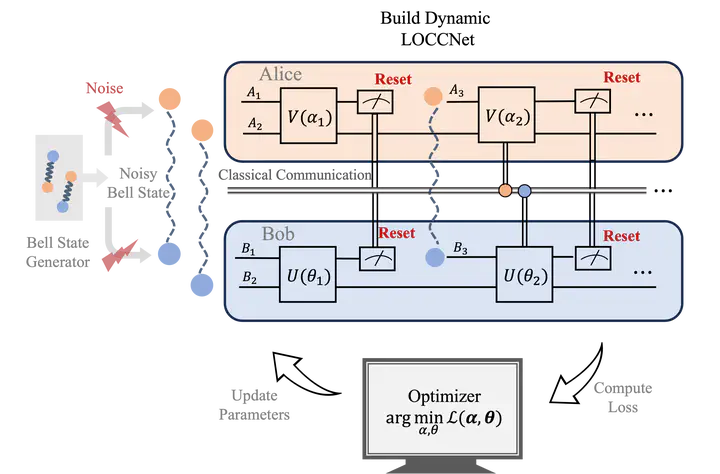 Optimizing an LOCC protocol with dynamic LOCCNet.
Abstract
Distributed quantum computing offers a promising pathway to overcome the limitations of individual quantum processors by connecting them into a networked system. Due to the physical constraints, the allowed quantum operation in the distributed quantum computing paradigm is local operations and classical communication (LOCC). However, designing practical LOCC protocols for large systems is generally challenging, often requiring exponential computational resources. Here, we propose a general and flexible framework called dynamic LOCCNet (DLOCCNet) for designing and optimizing LOCC protocols using optimization techniques. Rather than designing large-scale protocols directly, DLOCCNet decomposes the large-size problems into small, recursively trainable optimization problems. Protocols designed by this framework achieve performance comparable to existing methods while significantly reducing computational resource demands. We conduct numerical experiments to demonstrate its effectiveness in entanglement distillation and distributed state discrimination tasks.

Xia Liu
Research Associate
I obtained my B.S. in Mathematics from the Qingdao University. I obtained my doctoral degree in Cyberspace Security from University of Chinese Academy of Sciences. My research interests include quantum machine learning and quantum computing.
Jiayi Zhao
PhD Student (co, 2025)
I obtained my BS in Mathematics and Applied Mathematics from Jilin University under the supervision of Prof. Sen Zhu. I obtained my MS degree in Applied Mathematics from Zhejiang University under the supervision of Prof. Junde Wu. My research interests include quantum information theory, quantum computation and computational complexity.
Benchi Zhao
Visiting Scholar
I obtained my MS degree in Physics from Imperial College London. I was an intern at Baidu Research under the supervision of Prof. Xin Wang. I obtained my PhD degree in quantum information at Osaka University. My research interests include quantum error mitigation, quantum information theory and quantum computation.
Xin Wang
Associate Professor
Prof. Xin Wang founded the QuAIR Lab at HKUST (Guangzhou) in June 2023. His research aims to advance our understanding of the limits of information processing with quantum systems and the potential of quantum artificial intelligence. His current interests include quantum algorithms, quantum resource theory, quantum machine learning, quantum computer architecture, and quantum error processing. Prior to establishing the QuAIR Lab, Prof. Wang was a Staff Researcher at the Institute for Quantum Computing at Baidu Research, where he focused on quantum computing research and the development of the Baidu Quantum Platform. Notably, he led the development of Paddle Quantum, a Python library for quantum machine learning. From 2018 to 2019, he was a Hartree Postdoctoral Fellow at the Joint Center for Quantum Information and Computer Science (QuICS) at the University of Maryland, College Park. Prof. Wang received his Ph.D. in quantum information from the University of Technology Sydney in 2018, under the supervision of Prof. Runyao Duan and Prof. Andreas Winter. He obtained his B.S. in mathematics (Wu Yuzhang Honors) from Sichuan University in 2014.