Quantum coherence and distinguishability as complementary resources: A resource-theoretic perspective from wave-particle duality
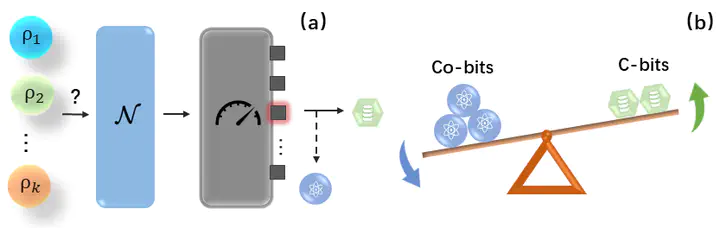 (a) QSD via free operations and (b) duality relation
Abstract
Wave-particle duality, a fundamental principle of quantum mechanics, encapsulates the complementary relationship between the wave and particle behaviors of quantum systems. In this paper, we treat quantum coherence and classical distinguishability as complementary resources and uncover a novel duality relation, which is explored through quantum state discrimination under incoherent operations, extending beyond typical interference scenarios. We prove that in an ensemble of mutually orthogonal pure states, the sum of ‘co-bits’, quantifying the coherence preserved under incoherent free operations, and classical bits, representing the distinguishability extracted via quantum state discrimination, is bounded. This coherence-distinguishability duality relation exposes an inherent trade-off between the simultaneous preservation of a system’s quantum coherence (wave-like property) and the extraction of its classical distinguishability (particle-like property). Our findings provide a fresh perspective on wave-particle duality through quantum resource theories, offering complementary insights into manipulating quantum and classical resources, with implications for quantum foundations and quantum technologies.

Zhiping Liu
Alumni
Chengkai Zhu
PhD Graduate
Xin Wang
Associate Professor
Prof. Xin Wang founded the QuAIR Lab at HKUST (Guangzhou) in June 2023. His research aims to advance our understanding of the limits of information processing with quantum systems and the potential of quantum artificial intelligence. His current interests include quantum algorithms, quantum resource theory, quantum machine learning, quantum computer architecture, and quantum error processing. Prior to establishing the QuAIR Lab, Prof. Wang was a Staff Researcher at the Institute for Quantum Computing at Baidu Research, where he focused on quantum computing research and the development of the Baidu Quantum Platform. Notably, he led the development of Paddle Quantum, a Python library for quantum machine learning. From 2018 to 2019, he was a Hartree Postdoctoral Fellow at the Joint Center for Quantum Information and Computer Science (QuICS) at the University of Maryland, College Park. Prof. Wang received his Ph.D. in quantum information from the University of Technology Sydney in 2018, under the supervision of Prof. Runyao Duan and Prof. Andreas Winter. He obtained his B.S. in mathematics (Wu Yuzhang Honors) from Sichuan University in 2014.